The word Mammon demon comes from the Aramaic terms mammon or mamon, which originally meant “that which is entrusted” or “that which is trusted.”
This meaning reveals an important truth about wealth. Money itself is neither good nor evil, but people can easily place too much trust in it.
Instead of becoming the centre of our lives, wealth should be used responsibly within relationships built on trust, generosity, and integrity.
Although many people today associate the Mammon demon with greed and materialism, the Bible primarily presents Mammon as a symbol of wealth competing for human loyalty.
Some later traditions and occult writings, including discussions about the ars goetia demon mammon, expanded this idea into a demonic figure representing the temptation of riches.
Jesus clearly warns about Mammon in Matthew 6:24, saying, “You cannot serve both God and Mammon.”
Similar warnings also appear in Luke 16:9, 11, and 13, where wealth is portrayed as something that can easily become a rival to God if it controls a person’s heart.
The same warning appears in the Parable of the Sower (Mark 4:19), where the “deceitfulness of wealth” is described as one of the reasons God’s word becomes unfruitful in someone’s life.
The story of the Rich Young Ruler (Mark 10:22) shows how attachment to possessions can become a major obstacle to following Christ.
This is one reason the Bible speaks about money so often. While there are roughly 500 verses about prayer, 500 about faith, there are more than 2,300 verses related to money and possessions, highlighting how seriously Scripture treats the subject.
Richard Foster summarises this danger by saying:
“Mammon asks for our allegiance in a way that sucks the milk of human kindness out of our very being.”
After the Holy Spirit was poured out at Pentecost, the early believers not only preached the Gospel and spoke in different languages, but they also willingly shared everything they owned (Acts 2:44).
Luke presents this as the fulfilment of the biblical principle of Jubilee (Leviticus 25), which Jesus announced during His ministry in Luke 4.
The Apostle Paul’s ministry also reveals how financial interests often opposed the spread of Christianity. In Acts 16:19, the owners of a slave girl reacted violently after losing their source of profit.
Later, in Acts 19:25, the silversmiths in Ephesus resisted Paul’s preaching because it threatened their business.
Throughout his ministry, Paul carefully avoided giving anyone the impression that he was preaching simply to make money (2 Corinthians 2:17). He even described greed as a form of idolatry (Colossians 3:5), warning that it separates people from God’s kingdom (1 Corinthians 6:9).
Instead, Paul encouraged generosity, equality, and practical care for those living in poverty (2 Corinthians 8).
The image of Mammon continued to develop in later Christian literature. In John Milton’s Paradise Lost, Mammon is portrayed as a figure who constantly looks downward at the golden streets of Heaven instead of lifting his eyes toward God.
This powerful image symbolises how an unhealthy desire for wealth can distract people from spiritual truth.
A similar lesson appears in the well-known story of Francis of Assisi meeting Pope Innocent III. The Pope proudly displayed the Church’s wealth and remarked, “No longer can the Church say, ‘Silver and gold have I none.'”
Francis replied, “Indeed, and neither can it say, ‘In the name of Jesus Christ of Nazareth, rise up and walk.'” The story reminds readers that spiritual power should never be replaced by material prosperity.
The Bible does not teach that every wealthy person cannot follow Jesus.
However, the Gospels consistently show that faithful followers who possessed wealth also practised generosity and willingly shared their resources with those in need.
As biblical scholar Craig Blomberg explains, genuine discipleship is not measured by how much wealth someone owns, but by how they use it to serve others and honour God.
Mammon Demon: The Personification of Greed and Wealth
Greed is known by many names, including avarice, cupidity, and covetousness. It describes an excessive desire to gain and keep wealth, valuable possessions, or even power and social status for personal benefit.
Instead of being satisfied with enough, greed drives a person to seek more without limits.
According to the quote attributed to Mammon:
“Greed is known by many things. It is also known as avarice, cupidity, or covetousness. It is the excessive desire to possess wealth, goods, or things of value for oneself. It fuels the pursuit of riches, power, and status. It does not weaken you—it gives you power. It gives you strength beyond what ordinary mortals can imagine. With such power, you become untouchable.”
In many occult traditions and fictional portrayals, the Mammon demon is presented as the living embodiment of greed, wealth, and material desire.
Also known as Maymun or Plutus in some traditions, Mammon is described as a powerful fallen angel and a high-ranking demon associated with avarice, prosperity, abundance, riches, injustice, and the temptation of material wealth.
Some modern stories and fantasy works go even further by portraying Mammon as a noble demon lord who grants forbidden knowledge and immense riches in exchange for loyalty or corruption.
In the Hellboy universe, for example, the Mammon demon is credited with forging Hellboy’s Right Hand of Doom and teaching humanity the secret of creating Homunculi.
Although many people search for information about the ars goetia demon mammon, it is important to note that Mammon is not listed among the 72 demons of the Ars Goetia.
Instead, the character is primarily recognised through biblical symbolism, medieval Christian writings, folklore, and later literary and fictional interpretations, where he serves as a lasting symbol of greed and the dangerous pursuit of wealth above all else.
Origin of the Mammon Demon
The name Mammon is widely believed to come from the Hebrew word ממון (mamôn), which means money, wealth, or material possessions.
Over the centuries, the word evolved beyond its original meaning and became a symbolic figure in Christian theology. Instead of referring only to riches, Mammon came to represent the temptation of wealth and the dangers of placing material success above spiritual values.
Today, the Mammon demon is commonly associated with greed, excessive wealth, and the desire for material possessions.
Although many people search for the ars goetia demon mammon, Mammon’s origins are rooted primarily in biblical teachings and later Christian tradition rather than the Ars Goetia itself.
The most well-known biblical reference to Mammon appears in the New Testament, where Jesus warns against allowing wealth to become one’s master. In Matthew 6:24, He says:
“No one can serve two masters. Either you will hate the one and love the other, or you will be devoted to the one and despise the other. You cannot serve both God and Mammon.”
This verse emphasises the conflict between spiritual devotion and the pursuit of material wealth.
Rather than describing the Mammon demon as a physical being, the passage presents Mammon as a powerful symbol of greed and misplaced priorities.
It reminds believers that when the desire for money takes control of a person’s heart, it can become a rival to faith and spiritual growth.
Appearance and fall of the Mammon Demon
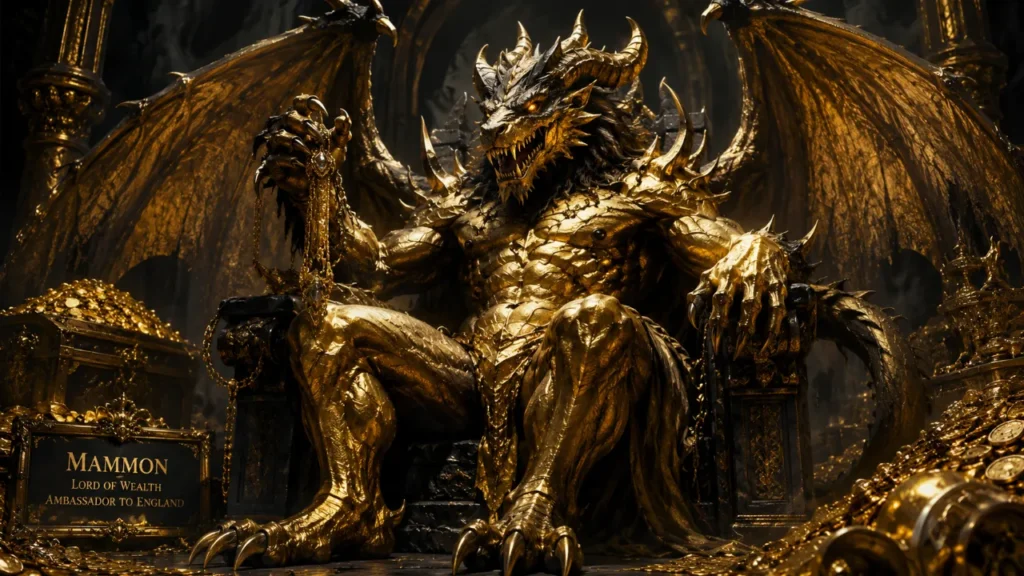
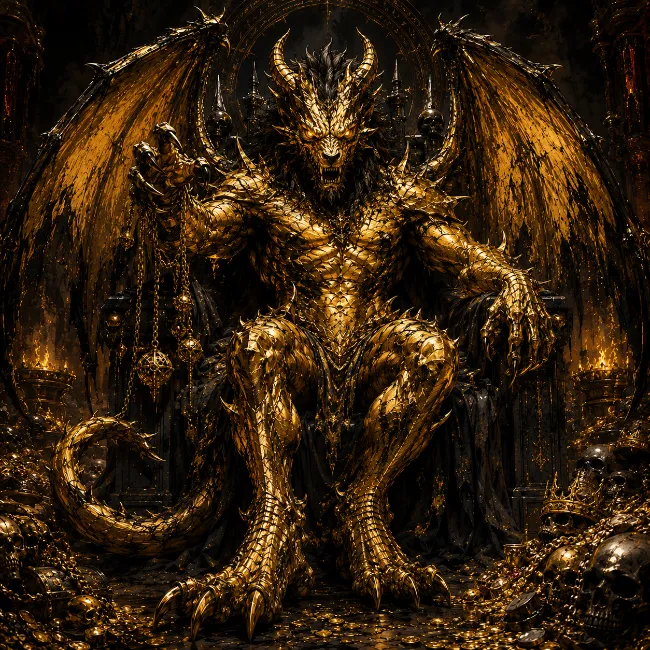
In many literary works and modern fictional interpretations, the Mammon demon is portrayed as a terrifying creature that represents wealth, greed, and material obsession. One popular depiction describes Mammon as a wolf-like demon, reflecting the medieval belief that wolves symbolised greed and an insatiable hunger for more.
His body is said to be covered in golden skin marked with dark, scorched patches, giving him a powerful yet corrupted appearance.
Sharp, curved spikes extend from his elbows, shoulders, and knees, while his feet resemble those of an eagle or dragon. His hands end in dragon-like claws, and he has a long dragon’s tail.
His wolf-like head has no visible lips, leaving his razor-sharp teeth permanently exposed. His glowing golden-amber eyes, set against black sclera, add to his intimidating presence.
When he spreads his wings, they shine with a golden colour, although the outer feathers appear blackened and burned.
Mammon Demon in Medieval Art and Literature
Throughout the middle Ages and the Renaissance, the Mammon demon became a powerful symbol of greed, avarice, and the corrupting influence of wealth.
Artists, writers, and theologians often portrayed Mammon not simply as a demonic figure but as the embodiment of humanity’s unhealthy obsession with money and material possessions.
In many medieval illustrations and literary works, the Mammon demon serves as a warning about the spiritual dangers of placing wealth above virtue.
These portrayals reinforced the belief that excessive greed could lead people away from faith, compassion, and moral values.
One of the most famous literary depictions appears in Dante Alighieri’s Divine Comedy.
In this classic work, Mammon is described as a wolf-like demon, reflecting the medieval association between wolves and insatiable greed.
He is portrayed as standing watch over the hoarders and spendthrifts in the Fourth Circle of Hell, where those who either selfishly accumulated wealth or wasted it recklessly face eternal punishment.
This striking image of the Mammon demon, surrounded by souls consumed by their love of riches, reinforces the idea that greed can enslave people just as much as any physical chain.
The eerie presence of the wolf-like guardian serves as a lasting reminder of the destructive power of uncontrolled desire for wealth.
Although many readers connect these stories with the ars goetia demon mammon, this particular portrayal comes from medieval Christian literature rather than the Ars Goetia.
It reflects the moral symbolism of greed instead of presenting Mammon as one of the traditional 72 Goetic demons.
Read : Alû: The Ancient Mesopotamian Demon of Nightmares 5 shocking fact and summoning ritual to know
The fall of the Mammon Demon
According to John Milton’s Paradise Lost and later literary traditions, Mammon was once an angel in Heaven. Unlike other angels, however, he constantly looked down at Heaven’s golden streets instead of lifting his eyes toward God.
His obsession with gold and material riches became stronger than his devotion to his Creator.
These stories describe Mammon as being so consumed by the pursuit of wealth that he showed little interest in Lucifer’s rebellion itself.
His greatest desire was not power or leadership, but the endless accumulation of treasure. Because he valued material wealth above God, he was ultimately cast out of Heaven by the Archangel Gabriel.
After his fall, the Mammon demon was banished to Hell. There, he became known as the demon who discovered vast deposits of precious metals beneath the earth.
Following Lucifer’s command, these riches were used by the fallen angels to build Pandemonium, the legendary capital of Hell.
Rather than encouraging further rebellion, Mammon advised the other fallen spirits to accept their fate and make Hell their permanent home.
This portrayal reinforces his role as a symbol of greed, materialism, and the belief that wealth can replace spiritual fulfilment.
Although many people search for the ars goetia demon mammon, this version of Mammon comes primarily from Paradise Lost, medieval Christian tradition, and later fictional works.
He is not listed among the 72 demons of the Ars Goetia, despite the widespread association found on the internet.
Characteristics of the Mammon Demon
The Mammon demon is commonly portrayed as a frightening figure who represents the dangers of excessive wealth, greed, and moral corruption. Rather than symbolising money itself, Mammon represents the destructive desire to place material riches above ethics, faith, and compassion.
The following characteristics are most commonly associated with the Mammon demon in religious traditions, literature, and folklore:
Greed and Avarice
The Mammon demon is widely recognised as the ultimate symbol of greed. His endless desire for wealth encourages people to chase riches without considering the moral consequences of their actions. This obsession with material gain often leads to selfishness, corruption, and spiritual decline.
Materialism
Mammon is closely linked to materialism. He represents the belief that success, happiness, and personal worth are measured only by money, possessions, and social status. This mindset places financial gain above spiritual growth and ethical values.
Corruption and Deception
In many legends and literary works, the Mammon demon is portrayed as a clever deceiver. Instead of using force, he tempts people with promises of wealth, luxury, and power, gradually leading them away from honesty, integrity, and compassion.
Influence over Humanity
Through the attraction of riches and prosperity, Mammon is believed to influence human behaviour. Stories often describe him as encouraging injustice, dishonesty, and immoral decisions by making wealth appear more valuable than virtue.
Read : 5 surprising powers of Foras demon and how to summon him for powers of invisible
Mammon Demon in Modern Culture
The Mammon demon continues to appear in modern culture as a symbol of greed, consumerism, and the pursuit of wealth at any cost.
His image is frequently used in literature, films, philosophy, and social criticism to explore the consequences of material obsession.
In Literature and Popular Media
From John Milton’s Paradise Lost to modern novels, films, comics, and video games, the Mammon demon is often portrayed as the embodiment of greed and corruption.
Writers use his character to illustrate how the desire for unlimited wealth can damage individuals, relationships, and society.
In Religious and Philosophical Thought
Many religious scholars and philosophers refer to Mammon as a warning against allowing wealth to become life’s highest priority. These discussions emphasise that when money replaces moral principles or spiritual values, it can lead to selfishness, inequality, and a loss of compassion.
In Economic and Social Criticism
The Mammon demon is also used as a powerful symbol in debates about modern economic systems.
Critics of unchecked capitalism and excessive consumerism often reference Mammon to highlight how the relentless pursuit of profit can contribute to social inequality, environmental damage, and ethical compromise.
Although many people search for the ars goetia demon mammon, most of these interpretations are rooted in biblical symbolism, medieval Christian literature, and later cultural works rather than the Ars Goetia.
In modern discussions, Mammon remains one of the most enduring symbols of humanity’s struggle between spiritual values and material wealth.
How to Summon Mammon for Money and Power
Many modern occult traditions describe rituals that are believed to help practitioners communicate with spiritual entities.
In these practices, the first step is to define a clear and specific goal and then choose an entity whose symbolic qualities are thought to match that intention.
For example, some practitioners associate the Mammon demon with financial prosperity, while other spirits, such as Astaroth or Furcas, are linked to knowledge, wisdom, or learning.
The next stage usually involves entering a deep meditative or trance-like state.
According to these traditions, this altered state of consciousness allows the practitioner to focus more deeply and become receptive to symbolic or spiritual experiences.
Various ritual tools may be used, including candles, ceremonial robes, daggers, wands, sigils, chants, or mantras. Others prefer a much simpler approach, relying only on meditation, sigil work, and repeated chanting.
Once the trance has been established, practitioners believe they may experience the presence of the Mammon demon in a personal and subjective way.
These experiences vary greatly from person to person and may involve vivid mental imagery, symbolic visions, strong emotions, or unusual sensations.
At this stage, the practitioner expresses their intention or request through a prepared prayer or their own words. When the communication feels complete, the ritual is formally closed.
Read : The Asmodeus demon of gambling and winning 2 Powerful Rituals and Prayers To Change Your Luck
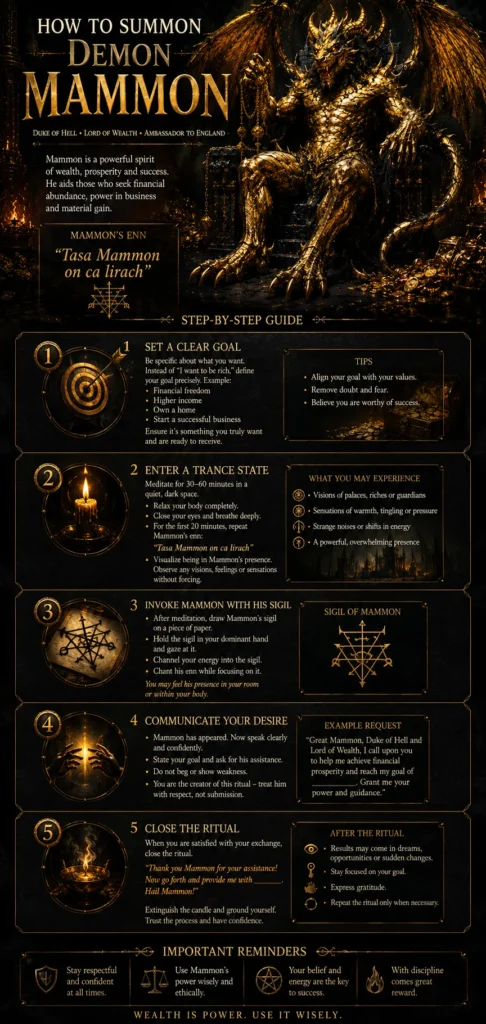
Traditional Ritual Process
Many modern practitioners describe the following general sequence when performing a ritual associated with the Mammon demon:
- Define a Clear Goal Begin with a specific intention rather than a vague wish. Instead of simply saying, “I want to be rich,” clearly identify what you hope to achieve, such as financial independence, a higher income, purchasing a home, or reaching another meaningful financial milestone. The goal should reflect something you genuinely desire and feel prepared to pursue.
- Enter a Trance or Meditative State Meditation is commonly recommended for 30 to 60 minutes to quiet the mind and improve concentration. Some traditions include repeating Mammon’s enn:
“Tasa Mammon on ca lirach.”
This chant is believed by practitioners to symbolically invite the presence of the Mammon demon during meditation. Individuals may then focus on visualising Mammon or observing any thoughts, images, or sensations that naturally arise.
- Work with the Sigil after meditation some practitioners draw Mammon’s sigil on paper and meditate while focusing on it. Chanting the enn may continue during this stage. Reports from practitioners describe sensations such as tingling, changes in temperature, or a heightened awareness, although these experiences are subjective and vary from person to person.
- State Your Intention Once the practitioner feels mentally focused, they communicate their goal clearly and confidently. Traditional teachings often encourage speaking with respect and confidence rather than fear or desperation, viewing the interaction as one based on purpose rather than submission.
- Close the Ritual The ritual concludes with a statement of gratitude. A commonly shared example is:
“Thank you, Mammon, for your assistance. Go forth and provide me with what I have requested. Hail Mammon.”
Practitioners note that responses are not always immediate or dramatic. Some report vivid visions or symbolic experiences, while others notice only subtle impressions.
Many traditions emphasise that regular meditation and practice are believed to improve focus and deepen future experiences.
Although many people search for the ars goetia demon mammon, it is worth noting that these ritual practices come from modern occult traditions and personal spiritual practices, not from the original Ars Goetia.
Experiences described during these rituals are subjective, vary widely between individuals, and are not scientifically verified.
Mammon Demon in Occult Traditions conclusion
In many modern occult traditions, the Mammon demon is described as a powerful spirit associated with avarice, greed, and material wealth. While Christianity and Judaism often portray Mammon as a symbol of excessive attachment to money, some esoteric beliefs present him in a very different way.
According to these traditions, Mammon was once regarded as a respected spiritual being connected with prosperity and abundance.
Some historical and occult sources claim that wealthy merchants and influential landowners honoured him as a patron of financial success and commerce.
Certain magical traditions even refer to Mammon as the “Ambassador to England,” linking this title to England’s long-standing reputation as a major centre of trade, banking, and commercial enterprise.
For centuries, practitioners of ceremonial magic and other occult systems have sought the guidance of the Mammon demon in matters involving wealth, business, and financial prosperity.
Many believe that he is especially responsive to petitions related to money, success, and material growth, which has helped maintain his reputation within modern occult circles.
Although many people search for the ars goetia demon mammon, it is important to note that these beliefs come primarily from later occult traditions and esoteric writings rather than the original Ars Goetia.
As a result, Mammon’s role varies depending on the religious, literary, or magical tradition being discussed.
FAQ
Q. Is Mammon one of the 72 Ars Goetia demons?
No, Mammon is not one of the 72 demons listed in the original Ars Goetia, which is the first section of The Lesser Key of Solomon. The traditional Goetic list includes demons such as Bael, Paimon, Astaroth, and Asmodeus, but Mammon does not appear among them. The confusion comes from modern occult books, fictional stories, and online sources that often group the Mammon demon with Goetic spirits because of his association with wealth and greed.
Q. Why do people call Mammon an Ars Goetia demon?
Many people refer to Mammon as an Ars Goetia demon because modern demonology and popular culture frequently combine different occult traditions. While Mammon is a famous figure associated with wealth, avarice, and materialism, his origins come primarily from the Bible, medieval Christian writings, and later occult traditions—not the original Ars Goetia. Modern books, games, and fictional works have contributed to this common misconception.
Q. What are the powers of the Mammon demon?
According to medieval legends and modern occult traditions, the Mammon demon is associated with wealth, prosperity, material success, greed, and temptation. Some esoteric beliefs describe Mammon as a spirit who can symbolically influence financial ambition or the pursuit of riches. However, these claims are based on religious symbolism, folklore, and occult traditions rather than historical or scientific evidence.
Q. What does Mammon represent in the Bible?
In the Bible, Mammon represents wealth and material possessions, especially when money becomes more important than faith or moral values. Jesus warned in Matthew 6:24 that “You cannot serve both God and Mammon,” using Mammon as a symbol of the temptation to place wealth above devotion to God. Over time, Christian tradition personified Mammon as a demon representing greed and avarice.
Q. Is there an official Mammon sigil in the Ars Goetia?
No. Because Mammon is not one of the 72 Ars Goetia demons, there is no official Mammon sigil in the original Lesser Key of Solomon. The sigils commonly found online are modern creations used in contemporary occult practices, books, or artistic interpretations. They should not be confused with the authentic Goetic seals preserved in historical manuscripts.