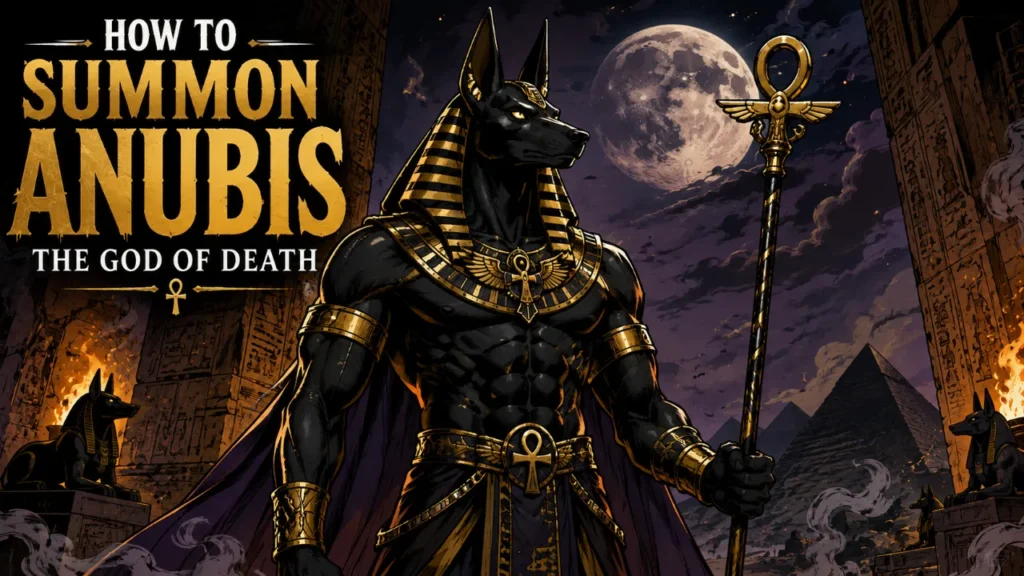
Anubis the God of Death: Rituals, Prayers, Offerings & How to summon Anubis god of death.
Anubis the God of Death is one of the best-known gods from ancient Egyptian mythology. He is also known by names such as Inpew, Yinepu, and Anpu. Anubis was closely connected with the dead, funerary rites, mummification, and the journey of the deceased into the afterlife.
He is sometimes described as the “God of the Holy Land” and was associated with Khentamentiu, an earlier funerary deity. Because ancient Egyptians associated the land of the dead with the western horizon, Anubis was also connected with the West and the realm of the dead.
Anubis is traditionally shown as a black jackal or as a human figure with the head of a black jackal. His distinctive appearance reflects his strong connection with cemeteries, burial grounds, and the protection of the dead.
In this article, you will learn about summon Anubis god of death, the Egyptian god of death, his history, worship, symbolism, and traditional associations. We will also explore ways people today may approach Anubis through prayer, offerings, meditation, and ceremonial invocation.
Some modern practitioners turn to Anubis when seeking protection, guidance, courage during periods of change, or personal transformation. However, it is important to understand the difference between ancient Egyptian religious practices and modern occult interpretations.
Anubis has been worshipped since ancient times, and evidence of his importance appears in some of the earliest Egyptian religious texts. His role developed over many centuries and was closely connected with funerary traditions.
In the Pyramid Texts, Anubis appears as a guide and protector of the deceased. He was associated with helping the dead enter the afterlife and with the religious traditions surrounding Osiris.
One passage describes the deceased being guided before the spirits and appearing before Osiris like Anubis Khentamentiu.
This connection between Anubis and the afterlife became one of the most important parts of his identity. Rather than representing death simply as an ending, Anubis was associated with the transition between life, death, and the afterlife.
One fascinating part of Anubis mythology is that ancient Egyptian sources do not give one single story about his parents.
Different periods and religious traditions provide different accounts of his birth.
Some early traditions connect Anubis with Ra, while other texts identify his mother as Hesat or Bastet. Another tradition describes him as the son of Ra and Nephthys.
In later mythology, Anubis is commonly described as the son of Nephthys and Osiris. One version of the story says that Nephthys disguised herself as Isis and became involved with Osiris.
These different stories are not necessarily contradictions. Egyptian mythology developed over thousands of years, and the identities and roles of many gods changed as different religious traditions became influential.
- How to summon Anubis god of death
How to summon Anubis god of death
People searching for how to summon Anubis god of death and chaos today are usually interested in modern spiritual or occult practices rather than ancient Egyptian temple worship.
A modern approach may involve creating a quiet ritual space, using symbolic offerings, saying a prayer or invocation, and spending time in meditation focused on Anubis.
It is worth remembering that there is no historically verified method that can demonstrate that a deity has been physically summoned.
Modern invocation practices are better understood as spiritual, symbolic, or devotional practices based on interpretations of ancient Egyptian religion.
If you choose to work with and learn how to summon Anubis god of death in this way, approaching the tradition with respect and learning about its historical background can make the practice more meaningful.
Ancient Egyptian texts closely associate Anubis with mummification and embalming. One of his titles was Imy-ut, often translated as “He who is in the place of embalming.”
He was also known as “He who presides over the pavilion of the god” (Khanty-she-netjer). This pavilion may have referred to a place where embalming was performed or, in some contexts, a burial chamber connected with the deceased.
Anubis and the Mummification of Osiris
Anubis also plays an important role in the famous Osiris myth. According to some versions of the story, Anubis helped Isis prepare and embalm Osiris after his death.
Other versions say that Anubis received or cared for the organs of Osiris after Set killed him. Because of his connection with the preservation and preparation of the dead, Anubis became closely associated with embalmers and funerary rituals.
His role was not simply connected with death itself. Anubis was also seen as a protector of the dead and a guide who helped the deceased make the journey into the afterlife.
Anubis and the Weighing of the Heart
One of the most important roles associated with Anubis and the afterlife is the Weighing of the Heart.
In ancient Egyptian funerary traditions, the deceased faced a judgment that determined whether they were worthy of entering the afterlife.
Anubis is frequently shown participating in this judgment by overseeing or performing the weighing of the deceased person’s heart.
The heart was weighed against the feather of Ma’at, which represented truth, justice, balance, and cosmic order.
If the heart was found to be in balance with Ma’at, the deceased could continue their journey into the afterlife. If the heart failed the judgment, it could be consumed by Ammit, the creature associated with the destruction of the unworthy dead.
This is why Anubis became such an important figure in Egyptian beliefs about death, judgment, protection, and the journey to the Duat, the realm of the dead.
Read : Mammon Demon Explained: Is the Ars Goetia Demon Mammon Real or a Myth? 5 surprising fact
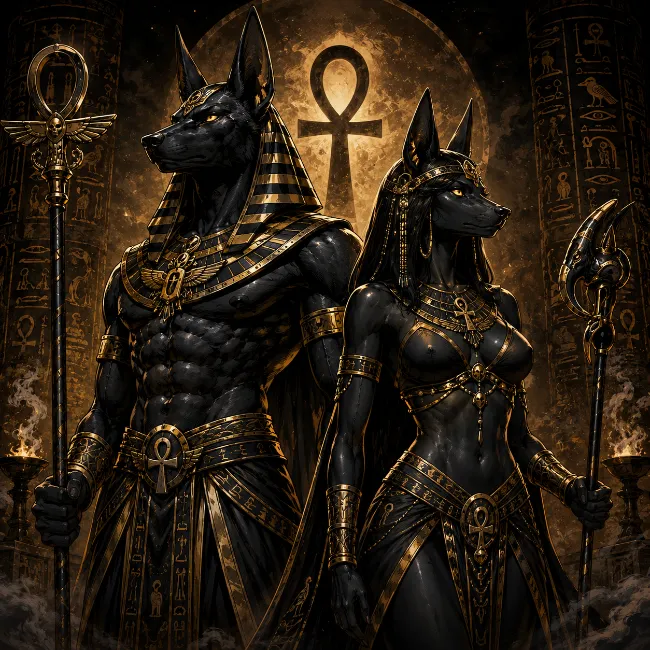
Anput, the Female Counterpart of Anubis
Anput is a female deity associated with funerary rites and mummification. She is sometimes described as the female counterpart of Anubis and, in some traditions, as his wife.
Like Anubis, Anput was connected with the protection of the deceased and the rituals surrounding death and burial.
Anubis’ the god of death Powers
Anubis was closely connected with tombs, burial grounds, mummification, and the protection of the dead. One of his roles was that of a “road opener” of the North, while Wepwawet, also known as Upuaut, was associated with opening the way in the South.
In this role, Anubis had a position that was comparable in some ways to Osiris, who was strongly associated with the realm of the dead.
Anubis was also regarded as a protector of the priests who performed mummification.
In Egyptian mythology, he was associated with the embalming of Osiris and with the preservation of the body after death. Because of this connection, he received titles such as “He who presides over the divine tent,” referring to the place where mummification took place, and “He who is over the bandages.”
Some funerary traditions also connect Anubis with a group of seven spirits mentioned in the Book of the Dead: Amset, Hapy, Duamutef, Kebehsenuf, Maa-an-tef, Jerybakef, and Mejenti-irti.
Anubis as a Protector
Anubis was primarily associated with protection, funerary rites, and the safe passage of the dead. Ancient Egyptian amulets, tomb paintings, and funerary texts show how important protective symbolism was in connection with Anubis.
Some later interpretations portray Anubis as having the power to place curses on enemies or protect people from harmful forces.
However, these ideas should be separated from the better-established ancient Egyptian traditions surrounding Anubis.
Modern occult traditions sometimes describe Anubis as a powerful deity who can be called upon for protection, spiritual guidance, transformation, and work connected with death and rebirth.
These interpretations vary widely and should not be confused with established historical evidence about ancient Egyptian religion.
Reasons to Work with Anubis
There are lot of reason why people look a simple ritual to summon Anubis god of death and chaos. Although Anubis is known as a guardian of the dead, many modern practitioners also approach him as a symbol of transformation, wisdom, protection, and personal change.
His connection with protection can make Anubis appealing to people who are going through difficult periods in life.
Some modern spiritual practitioners also view him as a guide for people who feel lost or uncertain about their direction. You can access hidden realm if you summon Anubis god of death and that’s the main reason why you should work with death god.
The idea of Anubis as a protector of travelers can also be understood symbolically. Instead of referring only to physical travel, some people interpret the journey as a metaphor for moving through different stages of life while searching for purpose and direction.
Anubis as a Guide during Difficult Times
Life can sometimes leave you feeling lost, isolated, or unsure about where you are going. You may be dealing with an important transition, an existential crisis, or a period when everything seems uncertain.
For people who connect with Egyptian spirituality, Anubis can represent a calm guide through these periods of change.
Rather than viewing him as a deity who simply gives commands, modern practitioners may see Anubis as a figure who encourages reflection and personal responsibility.
The choices remain your own, while the symbolism of Anubis can serve as a reminder to face difficult situations with patience and courage.
Read : Mantra to Prevent Enemy from Sleeping – 100% Powerful Islamic Ritual for Enemy Disturbance
Anubis and Personal Transformation
Another reason people choose to work with Anubis is his connection with transformation and change.
Anubis represents the transition between life and death, but this symbolism can also be applied to everyday life. Old habits, beliefs, relationships, or patterns sometimes need to end before something new can begin.
For this reason, Anubis can be a meaningful spiritual symbol for anyone going through a major change or seeking a deeper understanding of themselves.
His calm and neutral nature, as portrayed in many modern interpretations, may also appeal to people who want to become more patient, thoughtful, and balanced rather than acting purely on impulse.
Working with Anubis, therefore, does not have to be about fear or death. For many modern practitioners, it is about facing change, accepting endings, protecting what matters, and finding the strength to move forward.
Signs Anubis Is Calling You
If you feel drawn to Anubis the God of Death, it is important to approach him with respect, sincerity, and an open mind. In modern spiritual practice, Anubis is often associated with shadow work, personal transformation, death, rebirth, and facing the parts of ourselves that we normally avoid.
Some practitioners believe that Anubis may be a good spiritual guide for people who are willing to explore difficult emotions and honestly look at their fears, weaknesses, and hidden thoughts. If you are uncomfortable with themes surrounding death or the unknown, it may be better to learn about Anubis first before attempting any form of spiritual practice.
There is no single sign that proves Anubis is calling you. Spiritual experiences are personal, and what feels meaningful to one person may have a completely different meaning to another.
Common Signs Associated With Anubis
Some people interpret repeated encounters with symbols, animals, dreams, or other experiences as possible signs of a connection with Anubis.
These experiences can be physical or internal.
Physical signs may include repeatedly noticing:
- Jackals or dogs
- Black-colored animals
- Ankh symbols
- The Eye of Horus
- Bones or skeletal imagery
- Egyptian symbols and artwork
- Leopards or foxes
- Black and gold colors
- References to Anubis appearing unexpectedly
Non-physical experiences may include vivid dreams, unusual feelings during meditation, recurring thoughts about Egyptian mythology, or a strong intuitive feeling that encourages you to learn more about Anubis.
However, these experiences are not proof that Anubis is literally contacting you. Animals, symbols, dreams, and colors can have many ordinary explanations. It is better to consider them as personal spiritual symbols rather than unquestionable supernatural messages.
This is the simple but powerful symbol to connect with and learn how to summon Anubis god of death.
Dreams and Visions of Anubis
Dreams are one of the experiences that some modern practitioners associate with Anubis.
You might dream about a black jackal, a dog, an Egyptian temple, an ankh, a tomb, or another symbol connected with death and the afterlife. You may also experience vivid imagery during meditation.
If this happens repeatedly, write down what you experienced and how you felt at the time. Pay attention to the personal meaning behind the symbol instead of immediately assuming that it has only one interpretation.
Because Anubis is strongly associated with mummification, embalming, death, and the afterlife, recurring thoughts or dreams about these subjects may also be an opportunity to examine your own feelings about death, change, loss, or transformation.
For some people, this kind of reflection can become a form of shadow work, helping them understand fears or emotions they may have avoided.
Read : Who Is Dajjal in Islam? 5 strong Signs the end is near, Islamic End-Time Prophecy
Offerings while ritual to summon Anubis god of death
Offerings have traditionally been an important part of Egyptian religious practice. They can be understood as expressions of respect, gratitude, and devotion.
If you choose to create a modern devotional practice dedicated to Anubis, focus on sincerity rather than trying to find an expensive or complicated offering.
Anubis has several titles connected with death, embalming, burial, and protection. These associations can provide inspiration when choosing symbolic offerings.
Traditional and Symbolic Offerings
Common offerings associated with Egyptian religious traditions include bread and beer. For a modern practice, you can also use simple symbolic items such as:
- Bread or other food
- Incense such as frankincense or myrrh
- Flowers
- Ankh symbols
- Small statues or images of Anubis
- Egyptian-inspired artwork
- Written prayers or poems
- Personal artwork dedicated to Anubis
You can also make an offering through an act of kindness. For example, caring for an animal, helping someone in need, donating to a relevant charity, or maintaining a respectful memorial for the dead can become a meaningful symbolic act.
Creative Offerings
An offering does not always need to be a physical object.
You could write a poem or prayer for Anubis, create a drawing, paint an image, compose music, or spend quiet time reflecting on the qualities that Anubis represents.
If you feel connected to his symbolism of protection, transition, and transformation, you might dedicate an act of personal growth to him.
For example, you could decide to leave behind an unhealthy habit, confront a fear, or begin a practice of meditation and self-reflection.
Ankh as a Symbol of Anubis
The ankh is one of the most recognizable symbols of ancient Egyptian religion and represents life. An ankh can therefore be used as a meaningful symbolic object in a modern devotional practice.
Some practitioners choose to keep an ankh on an altar, wear one as jewelry, or place it near an image or statue of Anubis.
Rather than believing that an object automatically contains supernatural power, you can treat the ankh as a reminder of life, transformation, and the journey of the soul.
The most important part of any offering is not its monetary value. Respect, sincerity, and personal meaning matter more than how elaborate the offering is.
Prayers to Anubis
Prayer can be a simple way to connect with Anubis the God of Death through reflection, devotion, and meditation. You do not need an elaborate ritual to pray to summon Anubis god of death. What matters most is that your words are sincere and meaningful to you.
Here are two prayers that can be used as part of a personal devotional practice.
Prayer 1: A Prayer for Protection and Guidance
Anubis, protector of the dead,
I open my heart to you with sincere intentions.
Please hear my voice through my prayers.
Anubis, my guardian and protector,
Hear my prayers.
Anubis, God of the Holy Land,
I bring offerings of incense and liquor.
I pray to you, please give me your blessings.
Beloved Anubis, please protect me.
Beloved Anubis, please give me guidance.
Beloved Anubis, please protect me from the darkness within my heart.
Greetings to you, Anubis.
Greetings to you.
Read : Summoning Vual demon the great duke of Hell and master of Influence Love and 3 hidden knowledge
Prayer 2: A Prayer for Life and Strength
This prayer addresses Anubis by the name Anpu and focuses on life, strength, and protection.
O Anpu, give me life in my heart,
And life in my tongue,
And life in my hearing,
And life in my sight,
And life in my feeling,
And life in all my body.
Give me life before me,
And life behind me.
Give me, I pray thee,
Life on my right hand,
And life on my left hand,
And life above me,
And life beneath me.
O Anpu, increase the life within me
And give me life to thrive within.
If you are using a historical prayer or text, it is best to identify its original source rather than describing it simply as an ancient prayer. This simple prayers to summon Anubis god of death helps keep historical Egyptian material separate from modern devotional writing.
Anubis Rituals
Modern practitioners who want to practice quick and effective rituals to summon Anubis god of death may use prayer, meditation, visualization, and symbolic ritual as ways of focusing their attention on the deity.
These practices come from modern spiritual and occult traditions and should not be presented as historically verified ancient Egyptian methods.
Ancient Egyptian worship involved its own temple traditions, priests, offerings, funerary practices, and religious customs.
Invocation for Anubis
Invocation is another kind of ritual to summon Anubis god of death. An invocation can be performed in front of an image or statue of Anubis or at a quiet personal altar. You can summon Anubis god of death with simple invocation rituals.
A cemetery should only be considered if local rules allow it and you can do so without disturbing graves, visitors, or funerary activities. A private ritual space is usually a simpler and more respectful option.
Place a representation of Anubis in front of you. This can be a statue, image, or another symbolic representation.
Begin by sitting comfortably and meditating for a few minutes. Take slow breaths and allow distracting thoughts to settle. When you feel calm, focus your attention on the image of Anubis.
Visualize Anubis and reflect on the qualities you associate with him, such as protection, guidance, transition, and transformation. Here below is a powerful prayers to summon Anubis god of death and chaos.
You can then recite the following invocation:
Hail to thee, Anpu, Neb-ta-djeser.
Please, reveal yourself to me.
O protector of the dead and of the spirits,
O mighty one,
O master of secrets and ruler of the Underworld,
O Pharaoh of those in Amenti,
O you who decides the unworthy,
Please, reveal yourself to me.
My protector, my guide, my god whom I serve,
Come to the earth.
Please, reveal yourself to me
And guide me through the dark.
Hail to thee, Anpu, Neb-ta-djeser.
Rather than expecting a physical appearance, you can treat the invocation as a form of devotional meditation and symbolic communication.
Pay attention to your thoughts, emotions, dreams, and personal reflections afterward. There are so many ways you can perform to summon Anubis god of death.
Evocation for Anubis
Some modern occult practitioners use the term evocation for a more structured ritual intended to establish a focused spiritual encounter with a deity.
If you choose to practice this type of ritual to summon Anubis god of death, keep the setting safe, private, and respectful.
Step 1: Prepare Through Prayer
For three consecutive nights before the ritual, spend a few minutes praying or meditating on Anubis. You may also place a simple symbolic offering on your altar.
Step 2: Choose Appropriate Clothing
Wear clean and respectful clothing. Some modern practitioners who try to summon Anubis god of death prefer black or black-and-gold clothing because these colors are commonly associated with modern representations of Anubis.
Step 3: Create a Ritual Space
Place a pentagram or another symbolic design on the floor or altar if it is part of your personal practice. Add symbols associated with Anubis around the ritual space.
There is no historical evidence that a pentagram was an ancient Egyptian requirement for contacting Anubis, so this should be understood as a modern occult practice rather than an ancient Egyptian ritual.
Step 4: Place a Symbolic Stone
You can place a crystal or dark stone such as hematite or black obsidian in the center of your ritual space. This is symbolic and does not need to be considered a source of supernatural power. This is good opportunity to summon Anubis god of death.
Step 5: Light a Candle Safely
Place a black candle in a stable, heat-resistant holder. You can decorate it with an Anubis-inspired symbol if you wish.
Never leave a burning candle unattended, and keep it away from clothing, paper, curtains, and other flammable objects.
Step 6: Meditate and Visualize
Sit comfortably facing the candle or your image of Anubis. Meditation and trance state help you to feel connected and summon Anubis god of death. Close your eyes and begin meditating.
Take slow breaths and focus your attention on Anubis. Visualize his jackal-headed form and reflect on what he represents to you: protection, death, transformation, judgment, and the journey into the unknown.
Step 7: Recite the Invocation
When you feel focused, recite the following words:
Anpu, Neb-ta-djeser, embrace me, your follower.
Anpu, Neb-ta-djeser, heal me, protect me, be my guide in this human life.
Help me see the truth behind the curtains.
Let us unite; I will allow myself to receive your guidance.
Anpu, Neb-ta-djeser, let us unite.
Show yourself, protector of the dead.
Blessed be.
Step 8: Close the Ritual
When you are ready to finish the ritual to summon Anubis god of death, thank Anubis and bring your attention back to your surroundings.
You can say:
Blessed be.
Anpu, Neb-ta-djeser, thank you for your guidance.
Blessed be.
Anpu, Neb-ta-djeser, return my thoughts to me.
Guide me back into the world of the living.
Blessed be.
Take a few deep breaths, open your eyes, and give yourself a moment before returning to your normal activities.
Step 9: Clean the Ritual Space
Cleansing is essential part to perform ritual to summon Anubis god of death and chaos. Put away your ritual objects and clean the area.
If you use a candle, extinguish it safely rather than pouring alcohol or wine onto a burning flame. Allow the candle to cool before handling it.
You can keep your Anubis statue, image, crystal, or other symbolic objects on your altar for future meditation or devotional practice.
What to Expect After an Anubis Ritual
A ritual to summon Anubis god of death does not guarantee that a deity will physically appear or communicate with you.
Some practitioners may experience strong emotions, vivid dreams, meaningful thoughts, or a greater sense of reflection after meditation.
Record your experiences in a journal rather than immediately treating every dream, coincidence, or sensation as a supernatural message.
Over time, this simple ritual to summon Anubis god of death can help you understand what Anubis represents in your own spiritual practice and why you feel drawn to him.