Alû: The Ancient Mesopotamian Demon of Nightmares expalined. In the shadowy belief systems of ancient Mesopotamia, where gods ruled the skies and spirits haunted the unseen world, few entities were as feared as the demons that preyed on human vulnerability—especially during sleep.
Among these dark forces, Alû: The Ancient Mesopotamian Demon of Nightmares stands out as one of the most chilling. Unlike other demons that brought disease or misfortune, Alû was believed to attack the mind itself, slipping into a person’s dreams and turning rest into terror.
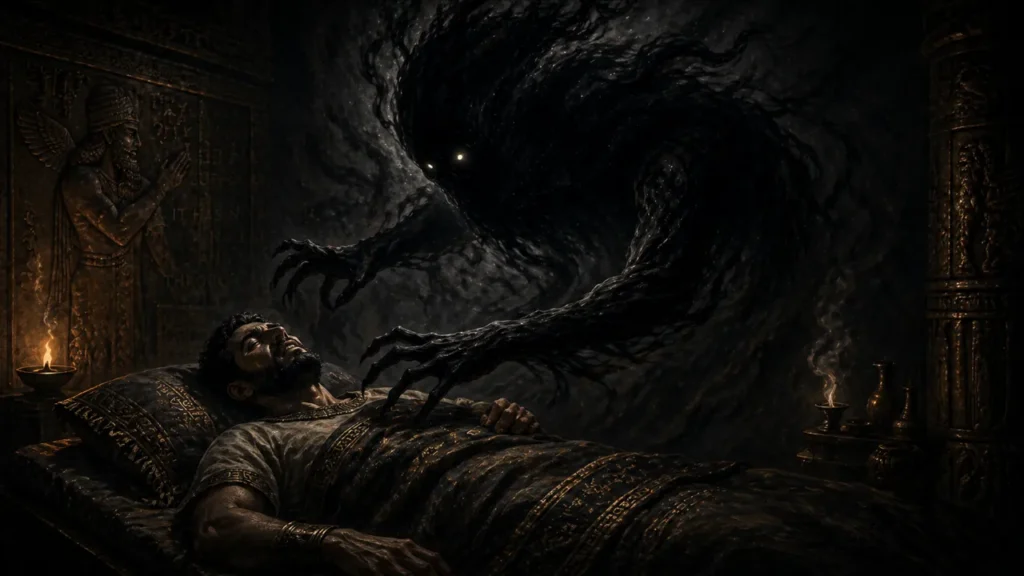
Ancient texts describe this entity as a silent, formless presence that would visit its victims at night, suffocating them with fear, confusion, and vivid nightmares that felt disturbingly real.
What makes Alû particularly unsettling is its lack of a defined shape. Mesopotamian scholars often portrayed it as an invisible or shadow-like being, making it impossible to detect or defend against.
This ambiguity only deepened its paranormal reputation, as people believed it could appear differently to each victim, feeding off their deepest fears and anxieties.
In some interpretations, Alû was even linked to sleep paralysis—a phenomenon where the body is frozen while the mind remains awake—giving rise to the terrifying sensation of being watched or held down by an unseen force.
The fear of such nightmare demons was so strong that ancient Mesopotamians developed rituals, incantations, and protective amulets to ward them off.
Priests and exorcists played a crucial role in identifying spiritual attacks and restoring peace to troubled sleepers.
Today, the legend of Alû: The Ancient Mesopotamian Demon of Nightmares continues to fascinate those drawn to the paranormal, offering a haunting glimpse into how ancient civilizations tried to make sense of the darkest corners of the human mind.
Who is Alû? Origins and Mythological Significance
Particularly in Akkadian and Sumerian traditions, Alû: The Ancient Mesopotamian Demon of Nightmares is portrayed as a deeply malevolent presence lurking within the spiritual landscape of ancient Mesopotamia.
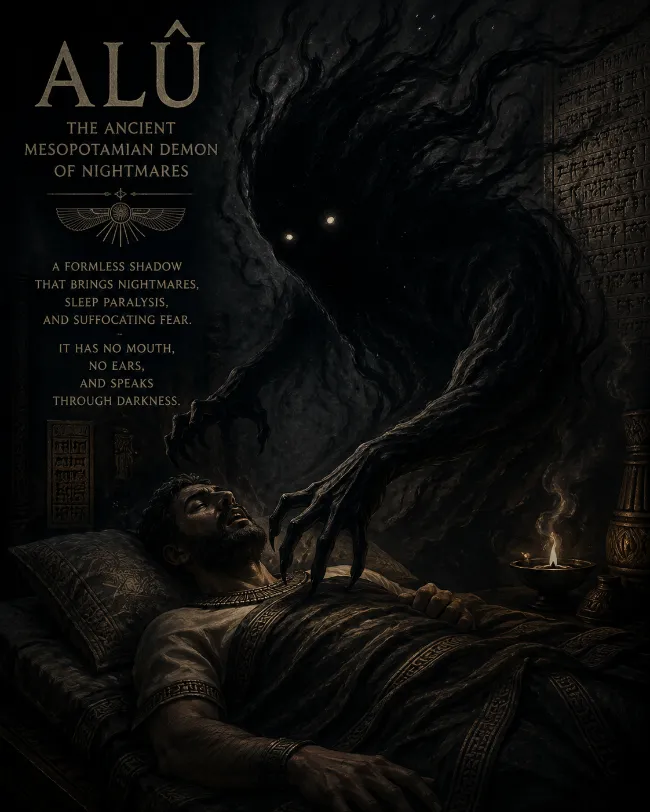
Unlike many other demons that were given grotesque or exaggerated physical forms, Alû is described as something far more unsettling—a being without a mouth, lips, or ears, existing as a formless shadow hidden within darkness.
This lack of identity made it even more terrifying, as it could not be easily recognized or resisted.
Instead, it silently targeted the human mind, invading sleep and leaving behind intense fear, confusion, and lingering dread.
Often associated with nightmares, sleep paralysis, and even possession, Alû was believed to torment the living not just physically, but psychologically.
The name Alû appears in several ancient sources, particularly within Akkadian incantations and Sumerian religious texts, where it is consistently linked to nocturnal attacks.
In these writings, Alû: The Ancient Mesopotamian Demon of Nightmares is depicted as a wandering spirit that strikes under the cover of darkness, disturbing sleep and inducing terrifying dream visions.
It was said to roam freely at night, seeking out vulnerable individuals and feeding off their fear, sometimes tormenting them seemingly for its own amusement.
Over time, interpretations of Alû evolved. Some scholars suggest that this entity may have originally been understood as a restless or wandering soul, a spirit unable to find peace.
However, as Mesopotamian demonology developed, Alû gradually took on a more defined role as a demon of terror, paralysis, and psychological disturbance.
This transformation reflects a deeper cultural attempt to explain the frightening and often unexplained experiences of the night—especially those that blurred the line between dreams and reality.
Connection to Nightmares and Sleep Paralysis
It was widely believed that an attack or possession by Alû: The Ancient Mesopotamian Demon of Nightmares could push a person into a state of unconsciousness, or even a deep, coma-like condition.
This chilling idea closely connects Alû to other night-associated entities such as the mara and the incubus, both of which were used in different cultures to explain the terrifying experience of sleep paralysis.
According to Mesopotamian belief, Alû would press heavily on a victim’s chest while they slept, leaving them unable to move, speak, or breathe properly.
This haunting description strongly mirrors modern accounts of sleep paralysis, where individuals awaken in a frozen state, often overwhelmed by the sensation that a dark, unseen presence is watching—or even sitting on them.
Because of its deeply disturbing nature, Alû: The Ancient Mesopotamian Demon of Nightmares was not only feared but also actively guarded against.
Ancient Mesopotamians took this threat seriously, developing protective practices to defend themselves from its influence.
Priests and spiritual practitioners would perform rituals, recite powerful incantations, and create protective amulets designed to repel such malevolent forces.
These measures were believed to create a spiritual barrier, preventing the demon from entering a person’s dreams or disturbing their rest.
Much like other ancient cultures that relied on charms and prayers to ward off supernatural dangers, Mesopotamians viewed Alû as a real and present threat lurking in the darkness of night.
Their efforts to protect themselves reveal not only the depth of their belief in such entities but also an early attempt to understand and cope with the frightening, unexplained experiences that occur between sleep and waking.
Alû’s Role in Occultism and Popular Culture
While Alû: The Ancient Mesopotamian Demon of Nightmares is not as widely recognized as figures like Lilith, Pazuzu, or Lamashtu, it remains a fascinating subject within the study of ancient Mesopotamian demonology.
Its subtle, almost invisible nature sets it apart from more vividly described demons, making it especially intriguing to researchers and enthusiasts of the paranormal.
Rather than relying on a terrifying physical form, Alû’s power lies in its connection to fear, darkness, and the unseen—qualities that make it feel disturbingly real even today.
In modern occult discussions, Alû is sometimes interpreted as a symbolic representation of psychological terror, embodying the hidden anxieties that surface during the most vulnerable moments of human consciousness.
Traces of Alû: The Ancient Mesopotamian Demon of Nightmares can also be found woven into modern horror culture.
Many films and works of literature feature shadowy, faceless entities that stalk their victims in the dark, feeding on fear and attacking during sleep. While these portrayals may not directly name Alû, the similarities are hard to ignore.
The idea of a formless presence that invades the night, paralyzes its victims, and creates overwhelming dread strongly echoes the ancient descriptions of this Mesopotamian demon.
This lasting influence highlights how deeply rooted such fears are, bridging the gap between ancient mythology and contemporary storytelling, where the unknown continues to terrify in ways that feel both timeless and universal.
Differences between Alû and Related Spirits
Alû vs. Gallu
When comparing Alû: The Ancient Mesopotamian Demon of Nightmares with Gallu, the differences reveal two very distinct roles within Mesopotamian belief systems.
Gallu were often seen as agents of chaos and transformation. While they could be destructive, they weren’t purely evil in nature.
In some traditions, they even served a purpose—acting as enforcers of fate or forces that pushed individuals to confront hardships and misfortune.
Their presence symbolized disruption, but also necessary change, making them more complex than simple embodiments of fear.
In contrast, Alû: The Ancient Mesopotamian Demon of Nightmares represents a far more personal and psychological threat. Rather than confronting individuals openly, Alû operates in silence and darkness, targeting victims during sleep.
Its purpose is not transformation but torment—bringing fear, nightmares, and distress without warning. This makes Alû feel more intimate and unsettling, as its attacks occur in the most vulnerable state of human existence.
Alû vs. Ugallu
A comparison between Alû: The Ancient Mesopotamian Demon of Nightmares and Ugallu highlights a striking contrast between harm and protection.
Ugallu, often depicted as a powerful lion-headed figure, was regarded as a guardian spirit. It was commonly invoked in rituals to ward off evil forces and protect individuals from malevolent entities.
In many ways, Ugallu stood as a defender against the very kind of darkness that Alû represents.
On the other hand, Alû: The Ancient Mesopotamian Demon of Nightmares embodies the chaos and fears of the night itself. Rather than offering protection, it thrives on vulnerability—feeding on fear, disturbing sleep, and leaving behind psychological and even physical distress. Where Ugallu shields, Alû invades; where one guards against darkness, the other is born from it.
These comparisons not only highlight the unique nature of Alû: The Ancient Mesopotamian Demon of Nightmares, but also reveal how ancient Mesopotamian culture understood the balance between protection and fear—between the forces that guard humanity and those that haunt it.
Read : The Asmodeus demon of gambling and winning 2 Powerful Rituals and Prayers To Change Your Luck
Ritual with Alû
Preparation for the Ritual
With a deep understanding of Alû: The Ancient Mesopotamian Demon of Nightmares, the coven carefully designed a ritual centered on protection, healing, and restoring peaceful sleep.
The approach was not about confrontation, but about strengthening spiritual boundaries and calming the mind.
To begin, they created a sacred space on a moonless night—symbolizing the peak of darkness, when Alû’s influence was believed to be strongest.
The area was prepared with black cloths and marked with protective symbols to establish a controlled, focused environment.
Ritual tools were then gathered, including black candles, salt for purification, protective herbs like rue, and a sigil associated with Alû to direct intention and awareness.
At the heart of the preparation was intention setting. The individual clearly expressed their desire to break free from the disturbances linked to Alû: The Ancient Mesopotamian Demon of Nightmares and to reclaim calm, uninterrupted sleep.
Conducting the Ritual
On the chosen night, the ritual unfolded in a series of deliberate and meaningful steps.
The space was first cleansed using sage smoke and saltwater, a practice intended to remove lingering negative energy and create a sense of safety.
Once purified, black candles were lit, symbolically absorbing negativity and forming a protective barrier.
The coven then recited an invocation—acknowledging the presence of Alû while firmly calling for protection against its influence.
Participants entered a meditative state, focusing on visualization. They imagined a warm, protective light surrounding the individual, forming a shield against fear and disturbance. In this state, negative energy was not fought, but transformed—reshaped into calm and clarity.
Offerings of herbs and water were placed near the sigil as a gesture of respect and gratitude. These offerings reinforced the intention of protection and harmony, aligning the ritual with supportive spiritual forces.
To close, the coven expressed thanks, gently extinguished the candles, and grounded themselves to release any remaining energy.
A sealing chant was performed to strengthen the protective barrier, ensuring that the influence of Alû: The Ancient Mesopotamian Demon of Nightmares would no longer disturb the individual.
Aftereffects and Ongoing Practice
In the days and weeks that followed, noticeable improvements began to emerge.
Sleep became more restful, and the intense nightmares gradually faded. Instead of waking with anxiety or fear, the individual experienced a growing sense of peace, clarity, and emotional balance.
Stress levels decreased, and there was a renewed sense of control over both mind and daily life.
As a continued practice, the coven recommended maintaining a dream journal. By recording dreams and impressions each morning, the individual could better understand their subconscious patterns, strengthening their inner awareness and reducing the likelihood of future disturbances linked to Alû: The Ancient Mesopotamian Demon of Nightmares.
Embracing the Power of Alû Mesopotamian Demon of Nightmares conclusion
Alû: The Ancient Mesopotamian Demon of Nightmares stands as one of the earliest known representations of a demonic entity linked to nightmares and paralysis.
Deeply feared by the people of ancient Mesopotamia, this shadowy presence embodied the terror of the unknown—an unseen force that could invade the mind and disrupt the fragile boundary between sleep and reality.
Unlike more vividly depicted demons, Alû’s formless and silent nature made it even more disturbing, as it could not be easily identified or understood.
Over time, Alû: The Ancient Mesopotamian Demon of Nightmares has continued to capture the imagination of scholars, paranormal enthusiasts, and storytellers alike.
Its connection to experiences like sleep paralysis gives it a unique place where mythology and real human phenomena intersect.
Whether interpreted as a literal supernatural being or as an ancient attempt to explain the frightening sensations of immobility and night terrors, Alû remains a powerful symbol of fear rooted in the darkness.
Even today, this ancient demon serves as a haunting reminder of how civilizations have tried to make sense of the unseen forces that disturb human consciousness.
Its legacy lives on not only in the study of demonology but also in modern horror narratives, where the idea of a shadowy presence lurking in the night continues to evoke deep, primal fear.
FAQ
Q. Who is Alû: The Ancient Mesopotamian Demon of Nightmares?
Alû: The Ancient Mesopotamian Demon of Nightmares is a shadowy, malevolent spirit from Akkadian and Sumerian mythology believed to attack people during sleep. Unlike other demons with physical forms, Alû is described as formless—lacking a mouth, ears, or clear shape—making it even more terrifying. It was feared for causing nightmares, sleep paralysis, and psychological distress by invading the human mind at night.
Q. Is Alû connected to sleep paralysis in real life?
Yes, many scholars and paranormal researchers believe that Alû: The Ancient Mesopotamian Demon of Nightmares may be an ancient explanation for sleep paralysis. Victims described sensations like being unable to move, pressure on the chest, and the presence of a dark entity—symptoms that closely match modern sleep paralysis experiences. This connection makes Alû one of the earliest recorded interpretations of this phenomenon.
Q. How did ancient Mesopotamians protect themselves from Alû?
To defend against Alû: The Ancient Mesopotamian Demon of Nightmares, ancient Mesopotamians used rituals, incantations, and protective amulets. Priests performed spiritual cleansing ceremonies, while individuals kept charms and herbs nearby to ward off negative energy. These practices were believed to create a protective barrier that prevented Alû from entering dreams or disturbing sleep.
Q. What makes Alû different from other Mesopotamian demons?
Unlike well-known demons like Pazuzu or Lamashtu, Alû: The Ancient Mesopotamian Demon of Nightmares does not rely on a frightening physical appearance. Instead, its power lies in its invisibility and psychological impact. It attacks silently through nightmares and fear, making it more subtle yet deeply disturbing compared to other demons.
Q. Is Alû still relevant in modern paranormal beliefs?
Absolutely. Alû: The Ancient Mesopotamian Demon of Nightmares continues to influence modern paranormal discussions and horror storytelling. Many shadowy entities seen in films and described in supernatural encounters closely resemble Alû’s characteristics. It is often viewed as a symbolic representation of fear, anxiety, and the unknown forces that affect the human mind during sleep.