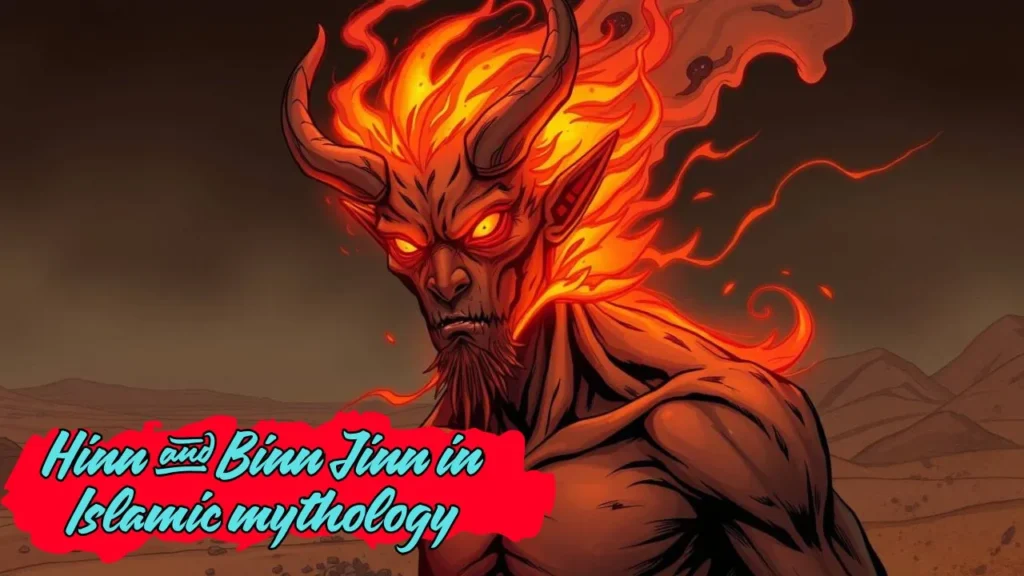
The Nasnas Jinn is undoubtedly one of the most mysterious and intriguing characters in Arab folklore and legends of the supernatural, grabbing the attention of people fascinated with ancient jinn stories and hybrid monstrous creatures.
It is very different from the genie, type jinn that are commonly depicted in modern stories.
Nasnas is depicted in traditional texts as a hideous, half, baked being, literally half a human with only half a face, half a chest, one arm, and one leg, which it uses to move with incredible speed and grace in lonely places.
The Nasnas Jinn, which has its roots in very old Arabian stories, is frequently depicted, not just as a jinn, but as the result of a Shiqq (a disgruntled jinn) and a human, thus explaining its twisted and unfinished form.
There, it is a metaphor for the merging of the human and supernatural worlds, and a warning against the consequences of crossing the limits between these realms.
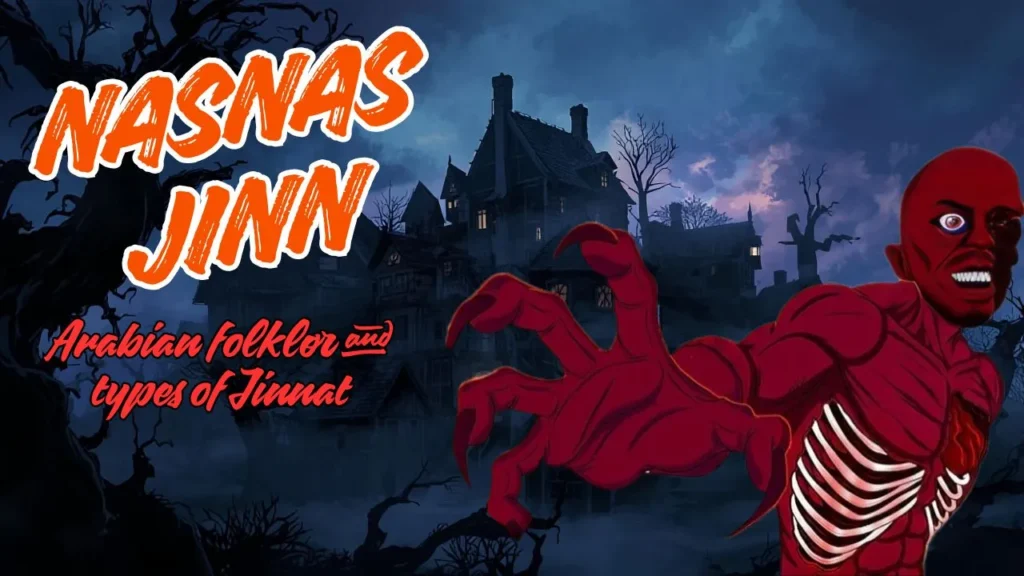
Even though it is not generally recognized in the mainstream Islamic texts, the Nasnas is a character that can be found in works such as One Thousand and One Nights and has been cited in literary and folklore contexts in the Middle East, where it is sometimes even found in Shii interpretative materials along with other jinn categories.
Its strange physical features and the disturbing picture of a creature that moves by hopping on just one limb make the Nasnas a favourite subject of jinn myths, supernatural beings, and folklore creature enumerations.
Whether it is in the traditional Bedouin desert or in modern times on the internet’s horror forums and folklore discussions, the Nasnas continues to be an intriguing symbol of the unknown and the uncanny a sign of the deeply ingrained supernatural narratives in the cultural imagination.
Arabian mythology and description of Nasnas Jinn
In the rich world of Arabian folklore and mystical stories, the Nasnas are strange and fascinating beings. Unlike powerful spirits like the sea-dwelling Marid or the fiery Ifrit, the Nasnas are seen as incomplete creatures, both in body and soul.
They are often described as having only one arm, one leg, and half of a face. While their appearance is frightening, their meaning goes much deeper than just horror.
For those who work with spiritual and energy practices, the Nasnas symbolize duality, inner shadows, and the unfinished parts of ourselves.
They represent what is hidden, broken, or waiting to be healed. Even though they are born from fear and imperfection, they teach important lessons about balance, self-acceptance, and personal growth.
The Nasnas come from Arab folklore, especially from pre-Islamic times and later stories linked to jinn.
Their origins differ in various tales. Some say they are children of demons, twisted forms of jinn, or cursed humans. Their incomplete form reflects imbalance and imperfection.
In legends, the Nasnas live in abandoned and empty places, such as ruins and wastelands.
They scare travelers and warn of the dangers of entering unknown or spiritual spaces without preparation. At the same time, they hold deep meaning.
They remind us of the harm caused by imbalance and point to the hidden parts of the mind that must be understood and healed.
Arabian mythology and symbolism of Nasnas Jinn
Even though the Nasnas look frightening, they carry deep spiritual meaning and important life lessons.
- Incompleteness: They represent the parts of ourselves that are still undeveloped, ignored, or pushed aside.
- Duality: Their half-formed bodies show imbalance, such as between light and darkness, masculine and feminine, or body and soul.
- Shadow and Fear: Their scary appearance reflects the fears and hidden emotions we avoid facing.
- Potential for Change: When we accept what is broken or incomplete, we open the door to healing and becoming whole.
So, the Nasnas are not just monsters from old stories. They act as symbols of human nature. They remind us that we are all unfinished in some way and that growth comes from understanding and accepting every part of ourselves.
Nasnas Jinn in Spiritual Practice and Occult
In today’s spiritual and energy practices, the Nasnas are regarded as helpers in the process of shadow work, healing, and personal transformation.
Despite the fact that their appearance is scary, working with their symbolism can allow people to encounter the parts of themselves they fear the most.
Shadow Work
The Nasnas Jinn symbolize parts of the self that are broken or hidden. Deep meditation on their figure can reveal inner fears, past traumas, or suppressed emotions.
By confronting what seems to be broken, we gain the ability to heal and complete ourselves.
Balancing Rituals
Besides, we can summon them when doing the work of balancing dualities, like masculine and feminine energies, activity and rest, or light and shadow.
Their divided body is a reminder that achieving harmony and balance in life is very important.
Energetic Protection
The Nasnas Jinn, though visually scary, may represent energetic shields as well.
Their intense presence is thought to be able to drive away negative or harmful influences thus they can be considered unusual but very strong allies in spiritual protection.
Spiritual Tests and Growth
Just as spirit guardians in other cultures, the Nasnas may be manifested in dreams or hallucinations as obstacles or tests.
To confront them is to confront one’s greatest fear, acknowledge the darker side of the self, and advance to the next level of spiritual development.
Read : Summoning Vual demon the great duke of Hell and master of Influence Love and 3 hidden knowledge
The dual nature of Nasnas Jinn
The Nasnas represent a powerful contradiction. They are incomplete, yet they hold great strength. Their presence may feel disturbing, but it reflects real truths about human life.
Everyone carries unfinished parts within them, such as unhealed pain, unrealized dreams, and hidden emotions.
When we react to the Nasnas with fear or rejection, they remain frightening. But when we approach them with respect and openness, they become teachers.
They guide us toward healing, balance, and inner wholeness.
For spiritual seekers, the Nasnas remind us that enlightenment is not about being perfect. It is about accepting what is broken and learning from it.
Their broken forms mirror our own inner struggles, such as the conflict between ego and soul, discipline and desire, love and fear.
Learning from the Nasnas means understanding that being incomplete is part of growth. Through acceptance and change, we move from feeling divided to feeling whole, and from darkness into light.
Modern occult practice and relevance of Nasnas Jinn
In our time, a lot of people experience a sense of incompleteness anxiety, feeling cut off, or leftover trauma. The image of the Nasnas fits very well with these human issues. By exploring their symbolism, therapists gain the ability to:
Face their hidden dark side. Recognize their damaged or unhealed parts. Accept imperfection as a step in spiritual evolution. Change fear into bravery and brokenness into unity.
As a matter of fact, the Nasnas are not about rejecting incompleteness, they are about confronting it bravely and deriving power out of it.
Lesson to learn from Nasnas Jinn
Nasnas jinn and their urban legend from Arabic culture represent their unique meaning in our life. A few people who look shortcut to become rich and women who want to get pregnant make a deal with Nasnas jinn.
- Wholeness requires embracing the broken. Only by accepting incompleteness can healing begin.
- Balance is sacred. Imbalance leads to distortion; harmony restores power.
- Fear reveals truth. What we fear most often hides what we must learn.
- Shadow is not the enemy. It is the mirror of growth and transformation.
Never trust on these types of jinn for any shortcut in your life. They resemble your greed and took advantage from it.
Read : Shiqq Jinn or Nasnas the spirit of Shadow fear and transformation 5 terrifying secret
Nasnas Jinn in Arabian mythology final conclusion
The Nasnas may look like frightening, half-formed creatures, but their deeper spiritual meaning is very powerful. They represent incompleteness, hidden shadows, and the discomfort that comes from imbalance.
Still, within their broken form is an important truth: when we face and accept what is damaged or unfinished inside us, real growth and unity can begin.
For those who practice spiritual and energy work, the Nasnas act as both a challenge and a guide.
They stand at the doorway of fear and invite us to step forward. They show us that strength exists in our shadows and remind us that imperfection is not weakness, but the starting point for change.
Walking with the Nasnas means having the courage to face what feels uncomfortable.
It means accepting what is incomplete and allowing it to shape us. Through this process, we become more balanced, more aware, and more alive.
FAQ
Q. What is a Nasnas in relation to jinn?
A Nasnas is a legendary supernatural creature from Arabic folklore often linked to jinn traditions. It is described as a half-formed being — with half a head, half a body, one arm, and one leg — and it moves by hopping with great agility. Its portrayal connects it to jinn and hybrid beings in mythic stories.
Q. Are Nasnas actually a type of jinn?
In many folk accounts, Nasnas are considered a lower or hybrid form related to jinn, sometimes described as the offspring of a shiqq (a half-formed type of jinn) and a human. Because of this origin story, Nasnas are often placed on the fringes of jinn lore rather than as mainstream jinn spirits.
Q. Why is the Nasnas half-formed?
The half-formed appearance of the Nasnas — literally being only half a human — symbolizes its hybrid nature between spirit and human, or between natural and supernatural. This form emphasizes its incomplete, liminal status in folklore.
Q. Do Nasnas appear in Islamic scripture?
Traditional Islamic texts like the Qur’an and mainstream hadith literature do not explicitly include Nasnas. The creature is primarily part of Arabian folklore and storytelling, and while it is sometimes discussed in cultural interpretations alongside jinn, it isn’t a formal theological category in Islam.
Q. What roles do Nasnas play in stories and myth?
In folklore, Nasnas often appear as eerie figures that wander remote places, frighten travellers, or embody imbalance and deformation. In some regions they surface in cautionary tales, while in others they symbolize deeper spiritual or psychological themes, such as fear, incompleteness, or threshold dangers.