Demon Bael is the one who draws the most attention among the seven principal spirits in the Ars Goetia, the famous grimoire from the Lesser Key of Solomon.
Occultists see him as a vital character who not only connects ancient Canaanite god worship to the riddles of the Middle Ages but also is a kind of bridge.
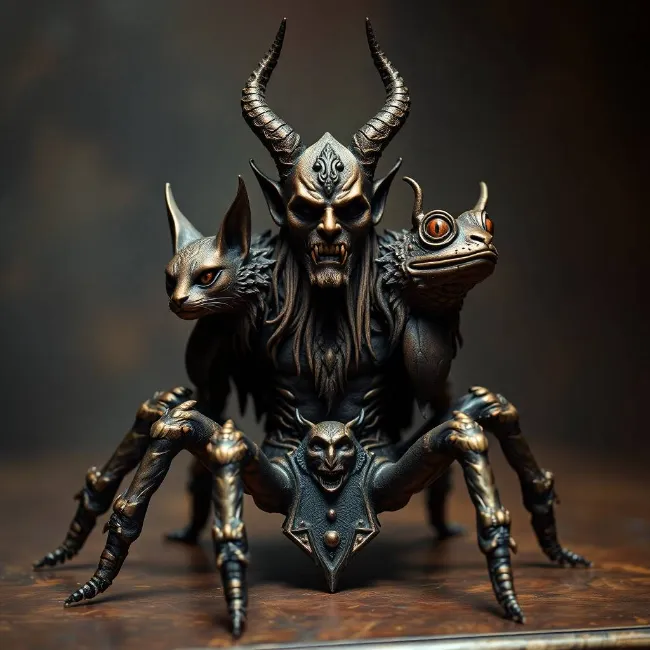
The three-headed image of Demon Bael—simultaneously a cat, a toad, and a human head—symbolizes his areas of deception, transformation, and intellect.
The medieval demonologists mentioned him widely in various grimoires, such as the Pseudomonarchia Daemonum and the Dictionnaire Infernal, and from their accounts, he was always a king with a hoarse voice and great power.
An extraordinary power over invisibility is what really enthralls occultists with Demon Bael over the past few hundred years.
Not only that Bael controls as many as sixty-six legions of demonic spirits but also he is a very powerful commander of unrest of a most influential type in the demonic hierarchy.
These legions are always ready to follow the summoner’s instructions and carry out complex magical operations on his behalf.
The grimoire traditions also assert Bael’s knowledge of the sciences besides which he has the power to win the favor of others thus making him versatile to any magical end.
Demon Bael still captivates the interest of those who seek knowledge beyond moral constraints and the hidden power.

Academic scholars and modern occultists are on his same wavelength and they study him thoroughly, acknowledging his pivotal role in the Western magical systems.
His documented abilities especially would be of interest to those who want to explore the border between the divine and demonic realms.
The extent of agreement between the authors of different period pieces as far as his portrayal is concerned is an indication that he is a strong archetype in the occult tradition.
Present-day magicians who call on the aid of Demon Bael are thus keeping alive an age-old practice that also allows them to be innovative with their craft.
His influence is very much alive both in demonology and among occult communities of today.
Table of Contents
Origins and Mythological Background of demon Bael
Demon Bael is an extremely old and historical person. He used to be a God taken from several different cultures and religions of the past.
The word “Baal” at first meant a number of gods that were worshiped in the Near East that was the home of Canaanite and Phoenician peoples.
When pass by their neighbors Jewish, Christian, and Islamic traditions, these civilizations have met each other, and Baal transformed radically.
Religious leaders looked at him in a different way and instead of calling him a god, they called him a demon who represents disobedience and corruption.
In Christian demonology, Bael became a prominent character due to the 16th and 17th centuries first hand documents very much dependent on factual data.
The Pseudomonarchia Daemonum and the Lesser Key of Solomon pointed out the organisation structure of Hell with Bael being the supreme ruler.
Powerful are the document which depict demon Bael as chief of most numerous troops of the hellish army and hence providing him the most potent entity to which the occult magician can hide in seeing through calling him, thus dating back invisibility cosignatory.
in this regard, the documents allow hein to the utmost ecstatic your magickal practice deity one among much of most e in the occult.
It was a transition going from a god to the leader of devils; hence, with re-interpretation by different traditions, such as the social constructs all along human existence, culture rebuilt and recast the spiritual of the past.
The growth of the new dogma in which the old spiritual had been integrated as new symbolic figures for contemporary religious and ethical orders was already there.
Appearance and Manifestation of Bael demon
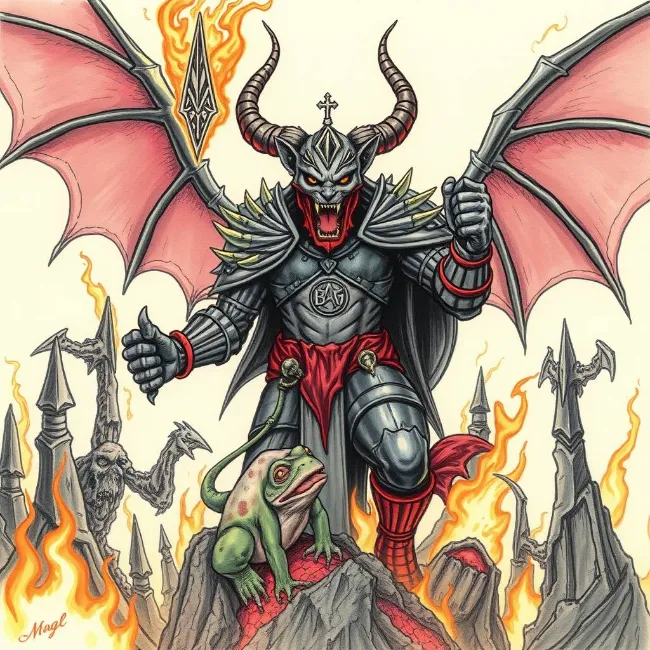
Bael is frequently represented as a disturbing trinity of beings that share a single body. On the one hand, Bael has three separate heads: a cat, a toad, and a human.
Every one of these heads represented a different aspect of the infernal domain belonging to him.
The cat’s face represents stealth, alertness, and cunning and it is used to show that he is a master of invisibility and misdirection.
The toad is a grotesque thing and it represents decay, transformation, and hidden wisdom that comes from dark and damp places.
On the other hand, the human head, intelligence, and calculated dominance, merges the concepts embodied by the other two heads.
In this way, demon Bael is not only a savage of chaos but also a governor of the equilibrium between instinct and intellect.
Manifestation of Demon Bael
First of all, Bael’s manifestation is stained with an overpowering vibe that distorts the air around it. The environment becomes even, and the summoner feels the burden of an unseen force falling upon him, indicating that the ancient one has come out of the way.
Also, the voice of demon Bael is extremely rough and husky and it is characterized by the echo that sounds as if it comes from different entities at the same time.
Witnesses say that they do not hear the words through their ears but rather they feel them in their chest. It is as if the words are not air-borne but vibrate through the body.
This spooky voice supports his power over the illusion and fear and therefore it gives the power to impose both respect and that feeling of uneasiness in almost equal degrees.
Shape-Shifting Abilities
One of the characteristic features of Bael is the one relating to his transformation abilities which he is a master of.
Individually, he can be any of the three forms or in numerous different ways he can be the combination of them for his presence or for his purpose.
In these changes, he shows that he is the ruler of infinite variations and that he is aware of them – he can change for deceiving purposes or for showing the hidden truths.
Symbolic Meaning of His Forms
The cat represents stealth and intuition. The toad signifies examples of corruption, transformation, and regeneration. The human form points to intellect and control.
With these, he tells us that Bael is the symbol that represents the unification of the primal, the decaying, and the conscious – the three levels of being that are in harmony bound up in one demon.
Powers and Abilities
Bael is most famous for his unique power of giving invisibility to the people who call him or serve him. With this power, an individual can be unnoticed, not just from the eyes of people but also from the spiritual viewpoint.
In magical lore, invisibility under Bael’s control stands for dominion over perception and the secret side of reality, thus endowing the summoner with the liberty to do as he pleases without being seen.
Command of 66 Legions
Bael, being one of the three kings of Hell, has the authority over sixty-six legions of infernal spirits.
The fact that he is in control manifests his vast power and sharp intellect, which is able to marshal a large number of beings to execute his orders.
The possession of this legionary command enables Bael to be considered both a leader and a king who is able to manage the underworld not only by maintaining order but also by mixing it with disorder.
Authority over Sciences and Wisdom
Bael’s brain is not only a weapon of war and deception. However, he is linked to the thorough knowledge of both the natural and the occult sciences and is seen as a source of insight into the hidden aspects of the universe and its riddles.
People, who need his help, are willing to part with their wisdom in exchange for understanding of alchemy, transformation, and the subtle forces that govern existence.
Their pact often ends with him revealing the truth in the form of confusing statements or enigmas, which in turn compels the summoner to challenge his/her own conventional logic.
Deceptive Capabilities
One of the greatest weapons in Demon Bael’s arsenal is deception. Illusion is in his hands like clay, by which he hides the reality beneath numerous layers of counterfeit and thus fools the observers’ perception.
With this ability, he can deceive both the living and the dead. This makes him a powerful ally and a very dangerous enemy at the same time.
Yet, Bael’s deception is not simply a play of tricks—it stands for the concept that the ultimate truth can be changeable, depending on one’s viewpoint and purpose.
Bael Role in Grimoire Traditions
Bael is the first demon mentioned in the Ars Goetia which is the opening part of the Lesser Key of Solomon, a major grimoire for European occultists.
He is the main king of Hell ruling the East and Bael is depicted as a spirit capable of making a person invisible and commanding sixty-six demon legions.
Appearance in Pseudomonarchia Daemonum
Also, Johann Wier’s Pseudomonarchia Daemonum puts Bael at the very top of the list and refers to him as the principal king among infernal spirits.
Here Bael is presented with three heads—a toad, a man, and a cat—and he is acknowledged for giving invisibility, wisdom, and for being the master of legions of demons.
References in Dictionnaire Infernal and Grand Grimoire
On the one hand, Demon Bael is the main focus of the Dictionnaire Infernal by Collin de Plancy and the Grand Grimoire and, as such, his power is emphasized not only as the head of the infernal forces but also as a very commanding figure in Hell’s hierarchy.
On the other hand, the Grand Grimoire talks about Bael as a subordinate of Lucifuge Rofocale but still acknowledges his power as a king with a great extent of authority.
Read : Demon Sitri one of Goetic demon and the Prince of Passion and Desire 5 Unique Powers
Kabbalistic Significance
In Kabbalah, Bael is the demon whose name is the subject of many mysterious meanings and whose Hebrew letters bet, ayin, and lamed are considered to reveal the secret of his supernatural powers.
Bael is associated with the qliphothic sphere of Netzach, signifying a perverted kind of authority and false victory—a shadow version of divine endurance and ambition.
His angelic counterpart is Vehuiah that stands for the cosmic opposition of demonic temptation and angelic guidance.
Bael demon summoning rituals
The invocation of Demon Bael usually requires detailed arrangements and a very strict ritual to follow.
Magicians purify their area, prepare the necessary ritual items such as fragrant herbs, lighted sticks, and a knife for ritual use, and make themselves ready by meditation or prayer.
The acts of purification separate the area of the ritual from the common world and help the power of the magician to focus, thus creating the atmosphere suitable for the contact with the spirit.
Usage of Sigils and Symbols
One of the major features in Bael’s summoning is the portrayal of the sigil of Bael – a symbol in the occult world, which is considered the representation of his power and his nature.
The sign is most of the time written down on a piece of leather of a parchment, drawn in the air with a magic stick or realized during meditation.
The sigil is the main idea of the summoner’s purpose and it also facilitates the link between the spiritual and material worlds.
Besides, workers might also incorporate other signs which might represent the power like planetary glyphs related to Bael into the work.
Sacred Circles and Commands
In order to provide safety and control during the event of calling, magicians make a protective circle on the floor by means of chalk, salt, or ritual tools.
Embracing the circle are the forces that the conjurer wants to keep away from his work: evil spirits and unwilled interferences.
The performance invites the use of certain conjurations, commands, or invocations from the classic grimoires to be recited.
The intended words of the ritual are uttered with power to bring Demon Bael into being and to make the spirit follow the summoner’s command.
Planetary Alignments
To achieve greater effectiveness, the occasion for the rite is in harmony with certain cosmic changes.
Often Demon Bael is linked with the planet Mercury which stands for communication and cleverness.
The summoner may decide on the most favorable days, astrological hours, or stages of the moon to coincide with the influence of Mercury, thus enhancing the power of the summoning and the possibility of establishing contact with the entity.
Bael demon appearance in Modern Cultural References
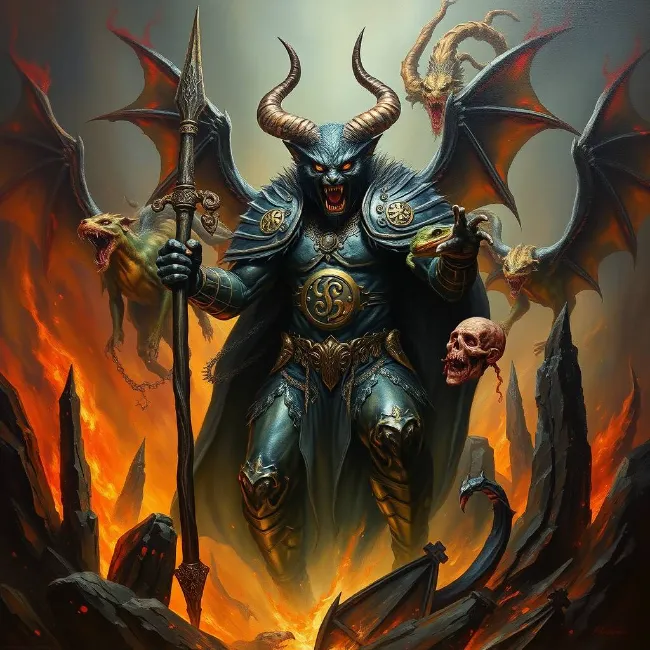
Bael has become a repeated character in modern entertainment and can be seen in popular video games, films, and TV shows.
Demon Bael in the Shin Megami Tensei video game series is shown with his famous three-headed form coming from old grimoires and is often depicted as riding a toad and having a black cat with him.
Bael in Bloodstained: Ritual of the Night is the final boss who attacks as three monstrous heads—a cat, a toad, and a human.
In the Diablo II game, Baal (Bael) is one of the main villains and is a clever, shape-shifting demon who deceives people easily.
On the small screen, Bael has been prominent characters in television shows like Ash vs Evil Dead, where he is a demon who manipulates and has terrible powers.
Contemporary Occult Practices
Demon Bael continues to be a focus of ritual and study by ceremonial magic and demonology practitioners in modern occultism.
Present-day occultists perform rituals with his sigil when they want to get the hidden knowledge or be invisible, they do this by taking the instructions from ancient texts like the Lesser Key of Solomon.
Bael is offered for obtaining knowledge, social influence, and personal power, but the main emphasis is on the symbolism and psychology rather than the literal expectation of a supernatural manifestation.
Popular Culture Depictions
Popular culture frequently reconstructs Bael’s mythos with the help of creative writing.
One of the ways Demon Bael is portrayed is by associating him with other legendary figures such as Baal and Beelzebub and in anime and Western fantasy stories as a powerful demon king or the ruler of the underworld.
Movies and books take advantage of his past to represent the characters of temptation, slyness, and the seeking of the forbidden power thus strengthening the position of the character as one of the archetypes which the characteristics of adaptability, trickery, and leadership among the infernal entities are derived from have been stable throughout time.
Read : Belial Demon his unique power and abilities how to summon him 5 amazing fact
Bael’s impact on modern demonology and ritual magic Conclusion
Bael’s heritage remains as one of the most notable and influential demonic figures from old grimoires, being consistently the main figure in both past and present occult traditions.
The lore of Bael includes his portrayal as a three-headed, shape-shifting king, commanding great authority, and having impressive powers, invisibility, and wisdom, in particular, which, for a long time, has served both as a deterrent and as a source of fascination to occult scholars and practitioners.
The symbolic intricacy of this character from the very beginning of time to now, keeps the scholars and the practitioners involved in these studies, alive which themes of secret knowledge, transformation, and the difficulty of balancing instinct, intellect, and corruption are raised.
Demon Bael is still a very significant character in the contemporary occult world; he remains the choice of invocation of those occultists who are seeking the facts that are hidden, the influence over the society, or the experience of the altered state of consciousness.
Although by some, his rituals and sigils are still used in magical ceremonies for the actual act of magic, most practitioners see them only as symbols of becoming empowered and thus conquering their psychological extremities.
The very powerful image of Bael as the one who can make himself invisible at will, as well as the one who has the sciences and the strategy at his disposal reflects the present-day mystical aspirations of gaining wisdom and freedom of one’s will.
Demon Bael’s intricate heritage serves as a bridge between the old and the new worlds and thus can be seen either as an archetype or as a spiritual entity.
In this way, He symbolizes the never-ending human quest to be able to dominate what is unseen and to be able to navigate the limits of conscious power.
FAQ
Q. What is the demon Bael known for?
Demon Bael is primarily recognized as the first king of Hell according to multiple medieval grimoires, including the Ars Goetia.
He is famous for his distinctive three-headed form—cat, toad, and human—and his ability to grant invisibility to those who summon him.
Bael also commands numerous legions of demons and is regarded as a master of deception and arcane knowledge.
Q. Who is Bael the demon in the Bible?
Bael does not appear directly in the canonical Bible, but he is often linked with Baal, a Canaanite deity referenced in the Old Testament.
Over time, Christian demonology reimagined Baal as Bael, assigning him a sinister status as a demon king.
In later occult texts, Bael is described as a ruler of Hell with specific powers, distinct from the biblical god Baal.
Q. Who is the most evil demon?
While Demon Bael is powerful and highly ranked in grimoires, the title of “most evil demon” varies depending on the tradition.
Figures like Lucifer, Satan, and Beelzebub often rank higher in terms of malevolence and influence.
Bael, however, is notable for his cunning, control over lesser demons, and unique blend of wisdom and stealth, making him formidable but not necessarily the most evil.
Q. What are demon Bael’s powers and abilities?
Bael wields several formidable abilities:
Grants invisibility to those who summon him
Commands 66 legions of demons
Possesses deep knowledge of occult sciences and can impart wisdom
Masters strategic deception and shape-shifting, allowing him to appear as a cat, toad, or human
Can influence social favor and manipulation in the mundane world
These diverse powers make Bael a sought-after figure for those pursuing knowledge and influence.
Q. What is demon Bael’s weakness?
Demon Bael’s weaknesses are typically referenced in ritual manuals, where he can be controlled or banished by invoking certain divine names or angelic authorities, particularly the angel Vehuiah.
Maintaining the protective circle, using his sigil properly, and adhering to precise rituals are crucial for summoners to safely interact with—or defend against—Bael’s influence.